Summary:
In the text “Studying Blacks and Horror Films”, it discusses how in many movies, Black people are often some of the first victims attacked in all types of films. In films like Jurassic Park, one of the first onscreen deaths is that of a Black guard. In film, Black people are often seen as “others”, while whites often hold the majority, in both population and culture. The lack of recognition is usually based on participation, or lack thereof. To be considered a horror film that fits the genre, you need five elements; it disrupts the everyday world, violates boundaries, upsets rationality, doesn’t have closure, and evokes fear. Horror films are also generally complex, often bringing culture and societal norms into the movies. Black characters are often cast to be underdeveloped background characters or they become the savage monsters themselves. That’s assuming they are even cast. Many horror films that take place in the nice suburbs don’t have any Black cast, implying racial stereotypes about who lives where. There is a difference between Blacks in Horror Films and Black Horror Films, one of which being that black horror films focus on race in addition to the normal focus’ in horror films.
Analysis:
The film Candyman is a Blacks in Horror Film movie. Candyman has a lot of the elements of becoming a Black Horror Film, but it falls short in a few categories. In the text, it’s stated how Black Horror Films often include specific tropes, those being, “church rituals, Black urban spaces, Black masculinity performances, and Black vernacular, music, style, and other aesthetic features.” While Candyman has a good amount of Black urban spaces, masculinity, and style. You can see the urban space where Anne Marie and her baby live and where the Candyman lives. You can also see that when Helen investigates the bathroom that the boy was murdered in. You can tell these places fall into the Black urban category because they fit the stereotypical ideas that they’re covered in graffiti and broken down and dilapidated. The Black masculinity is obvious with the Candyman’s whole persona and attitude. You can also see this masculinity when Helen and Bernadette are walking into the apartments, and they’re being catcalled and propositioned. The style can be seen in how the Candyman dresses, and how the catcallers dress stereotypically to what’s expected of them.
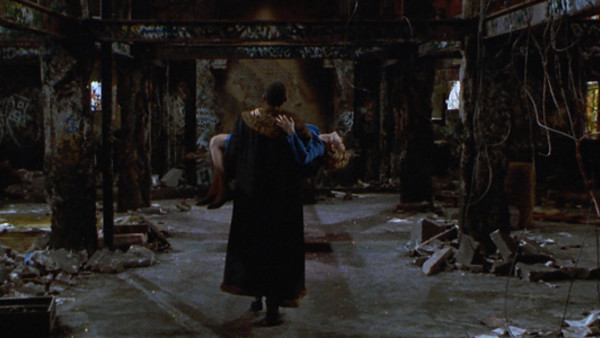

In Candyman, Blacks are both, “the thing that horrifies, [and] as the victim or that which is terrified.” The human Candyman and his gang are the monsters when they attack Helen in the bathroom. The Candyman himself is also the thing that horrifies, and they are both Black men terrifying the general public. Black people are the ones being terrified. Anne Marie is being harrassed because of Helen, and her baby is stolen from her by the monster that is the Candyman. The people in the building are also all terrified of the Candyman, and what he’ll do to them if he catches them talking about him to anyone.
In the text, it says how film director D.W. Griffith called Blacks “bêtes noires, or black beasts.” This lends to the ideas that Blacks are often not really valued as characters in horror films. In Candyman, the Candyman could be described as a black beast. He’s a monster who goes around killing people, with no remorse. He’s a beast that is going around on killing sprees and hurting innocent people. He doesn’t show any remorse after stealing the baby or after any of the people he murdered. He’s like a beast, and this is the only comparison that matches the description of black beast. The calling Black people as a whole “black beasts” fits into the stereotypes of Black behaviour and attitudes.
 Kacie's Blog
One thought on “Candyman!”