A Nightmare on Elm Street Part 2: Freddy’s Revenge!

Summary:

    In the text, “The Monster and the Homosexual”, it says how in 1984, a study came out that was very anti-homosexual. It stated more or less that homosexuals could be anyone, that they were a threat to those around them, and that it was a threat to traditional family values. The AIDS crisis added to the idea that gay was contageous, and that homosexual meant monsterous. Critic Wood said that horror films could be broken down into three variables; the normal, the other, and the relationship between the two. The male homosexual becomes monsterous due to him exhibiting feminine qualities. If homosexual couples appear on screen, they generally fall into the “one is masculine, one is feminine” ideals of a heterosexual couple. Watney says how straights need gays in order to be straight, meaning how without gays, there wouldn’t be a reason to identify as straight due to their being no other, looked down upon option. The text goes on to say how homosexuals and monsters alike are permanent residents of the dark and shadowy places.

Analysis:

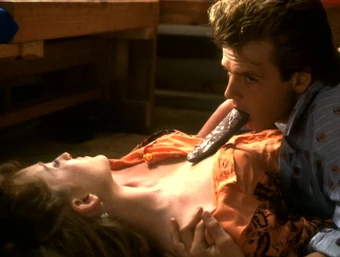
    In the film A Nightmare on Elm Street Part 2: Freddy’s Revenge, Freddy is the representation of Jesse’s repressed homosexuality. Freddy takes over Jesse over the course of the movie, changing him. When Jesse tries to get intimate with Lisa, Freddy emerges and stops him in his tracks, and sends him running to Grady. Jesse thinks that Grady might be able to protect him, but then Freddy emerges and slaughters him. Jesse goes straight back to Lisa, where Freddy massacres the partiers. In the scene where Lisa confronts the Freddy-Jesse hybrid, she stalls him when she says that she loves him. She claims that she’s going to take Jesse back from Freddy because she loves him. Lisa’s love for Jesse is the eradication of Jesse’s homosexuality. Lisa’s love “fixed” him, and therefore got rid of Freddy.
A Nightmare on Elm Street 2 | RiffTrax Wiki | Fandom
Credit: New Line Cinema

    Although it is never said outright in the film that Jesse is homosexual, the text states how the, “most important way that homosexuality enters the genre is through subtextual or connotatvive avenues.” This can be seen in the scene where Jesse is unpacking his room, where he dons a baseball cap, sunglasses, and lip syncs to a pop song. He also butt-bumps his draw shut, which isn’t something you’d see a stereotypical straight man do. He’s bad at sports, getting hit with a baseball during his gym class, and struggling to keep up with Grady when they’re running together.

Jesse ass bump - YouTube
Credit: New Line Cinema

    In horror films, homosexuality is often seen as what makes people the “other.” In the text, they say how, “the queer […] revels in the discourse of the loathsome, the outcast.” This idea of being an outcast is seen in the film. In the first scene on the bus, Jesse appears as the weird kid who the girls are laughing at and no one wanted to sit with. He was the new kid at school, and this made him an outcast in that sense too. Once Lisa made Freddy get out of Jesse and they could be together with nothing in the way, Jesse is no longer the outcast. People greet Jesse as he gets on the bus, and he sits with Lisa, no longer the loner who no one wanted to be near.

    The horror film genre is shifting from the stereotypical endings. Instead of the villain being banished or killed, he lives on in this movie. While Freddy was causing Jesse to commit the murders, it was still him who committed the murders. In the text, it says that newer horror films are going against the status quo by, “allowing the monster to live at the films end.” By letting Jesse live, it implies that all the connotations of him being queer could be fixed, or cured. By banishing Freddy, or Jesse’s homosexuality, Lisa suceeded into fixing him to be a straight man at the end of the film.
Candyman!

Summary:

    In the text “Studying Blacks and Horror Films”, it discusses how in many movies, Black people are often some of the first victims attacked in all types of films. In films like Jurassic Park, one of the first onscreen deaths is that of a Black guard. In film, Black people are often seen as “others”, while whites often hold the majority, in both population and culture. The lack of recognition is usually based on participation, or lack thereof. To be considered a horror film that fits the genre, you need five elements; it disrupts the everyday world, violates boundaries, upsets rationality, doesn’t have closure, and evokes fear. Horror films are also generally complex, often bringing culture and societal norms into the movies. Black characters are often cast to be underdeveloped background characters or they become the savage monsters themselves. That’s assuming they are even cast. Many horror films that take place in the nice suburbs don’t have any Black cast, implying racial stereotypes about who lives where. There is a difference between Blacks in Horror Films and Black Horror Films, one of which being that black horror films focus on race in addition to the normal focus’ in horror films.

Analysis:

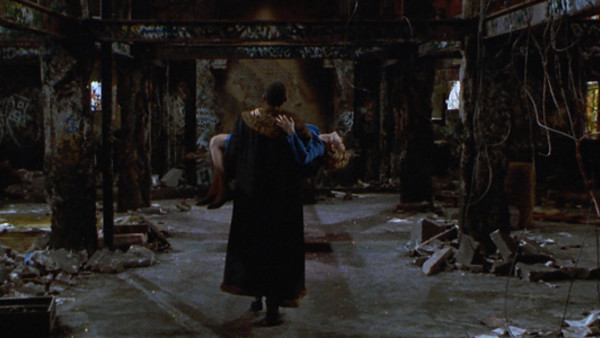
    The film Candyman is a Blacks in Horror Film movie. Candyman has a lot of the elements of becoming a Black Horror Film, but it falls short in a few categories. In the text, it’s stated how Black Horror Films often include specific tropes, those being, “church rituals, Black urban spaces, Black masculinity performances, and Black vernacular, music, style, and other aesthetic features.” While Candyman has a good amount of Black urban spaces, masculinity, and style. You can see the urban space where Anne Marie and her baby live and where the Candyman lives. You can also see that when Helen investigates the bathroom that the boy was murdered in. You can tell these places fall into the Black urban category because they fit the stereotypical ideas that they’re covered in graffiti and broken down and dilapidated. The Black masculinity is obvious with the Candyman’s whole persona and attitude. You can also see this masculinity when Helen and Bernadette are walking into the apartments, and they’re being catcalled and propositioned. The style can be seen in how the Candyman dresses, and how the catcallers dress stereotypically to what’s expected of them.

10 Horror Movie Romances That Make Love Terrifying – Page 2
Credit: Universal Pictures
Candyman – CMS 353: Horror Film
Credit: Universal Pictures

    In Candyman, Blacks are both, “the thing that horrifies, [and] as the victim or that which is terrified.” The human Candyman and his gang are the monsters when they attack Helen in the bathroom. The Candyman himself is also the thing that horrifies, and they are both Black men terrifying the general public. Black people are the ones being terrified. Anne Marie is being harrassed because of Helen, and her baby is stolen from her by the monster that is the Candyman. The people in the building are also all terrified of the Candyman, and what he’ll do to them if he catches them talking about him to anyone. 

    In the text, it says how film director D.W. Griffith called Blacks “bêtes noires, or black beasts.” This lends to the ideas that Blacks are often not really valued as characters in horror films. In Candyman, the Candyman could be described as a black beast. He’s a monster who goes around killing people, with no remorse. He’s a beast that is going around on killing sprees and hurting innocent people. He doesn’t show any remorse after stealing the baby or after any of the people he murdered. He’s like a beast, and this is the only comparison that matches the description of black beast. The calling Black people as a whole “black beasts” fits into the stereotypes of Black behaviour and attitudes. 

The Babadook!

Summary

    In the text “It’s Alive, I’m Afraid”, it says how all monsters are symbols of the birth process. In a way, the experimentation with human recreation in films inspired what became birth control pills. This lead to a sexual revolution because now women could be free to have sex with whoever they wanted without worrying about getting pregnant. This really helped to reshape female sexuality, but there were drawbacks. An untested drug called Thalidomide was released as something to help with morning sickness. This drug caused awful, monstrous birth defects in children, some being born with no arms or legs. People were scared of what was happening, and were killing the babies because they didn’t want defective kids. This led to the begining of people seeing women giving birth as a monsterous event. This mindset eventually developed into childrens toys, like the Cabbage Patch Kids, who aren’t born, but are from the cabbage patch, getting rid of the idea of childbirth. 

Analysis

    In the film The Babadook, Amelia’s husband died while he was driving her to the hospital to give birth to their son, Samuel. This is where Amelia’s life begins to spiral. In the text, it’s stated that the womb became, “the new graveyard from which the horror mavens would take their raw materials for the new put-together monsters”, which is true especially for Amelia. In giving birth to her son, she lost the man she loved, and gave birth to what some people would call a monster. Samuel is called a freak by kids and adults alike, because of the way that he acts. He makes weapons and brings them to school, and he doesn’t seem to have a verbal filter. All these things make Samuel a freak in the eyes of the people, and leads to him and his mother becoming more and more isolated. Amelia gives birth to Samuel, and her own sister won’t allow him to play with her daughter. Samuel is the monster to Amelia’s sister and the administration at school. Instead of working with Samuel and trying to get him help, the principal at the school assigns him a minder so he won’t get into any more trouble. Sameul is a prime example as the “fetus-as-bogeyman” that the text refers to, only he has grown into a child-monster in the eyes of his aunt and peers. When Samuel pushes his cousin out of the treehouse, it’s the final straw that his aunt can handle. She tells Amelia that she wants nothing to do with the family anymore, and nothing to do with the freak of a son that she’d had.

Yarn | This is my tree house. You're not allowed in here. ~ The ...
Credit: IFC Midnight

    In a way, the Babadook was also birthed by Amelia, though unintentionally. When she read the book to Samuel, she unknowingly gave the Babadook what it needed to start attacking them. The reading of the book in this case was the equivalent of its “birth”, and it follows the theme that birth is monstrous. In the text, it is stated that, “reproduction was a kind of death.” The Babadook caused the death of the family dog, and nearly killed both Amelia and Samuel. Once the Babadook appeared, it made Amelia see visions of her dead husband, which nearly drove her mad enough to end the lives of herself and Samuel. The Babadook caused their lives to become worse and worse until Amelia eventually almost killed Samuel in a car crash, and then by strangling him. 

THE HORROR DOGS: The Babadook (2014)
Credit: IFC Midnight

The Stepfather!

Summary:

    In the text “Trying to Survive on the Darker Side: 1980s Family Horror”, Williams talks about how the patriarchy is a huge part of the family structure in horror films. Williams says that while horror films were shifting, in the 80’s especially they were focused on family values. He also discusses how Clover thought that having the final girl face off against the monster, leading to her becoming more masculine by the end of the movie where she faces off the killer. Williams also says how familial dysfunction becomes more of a prevalent theme in horror films, that usually fall in line with marginalized families rather than upper-middle-class families. The horror films also delve into the theme that the parents won’t believe anything their teens tell them, therefore unintentionally helping the killer isolate and then kill their kids as seen in the Nightmare on Elm Street movies. Willaims also says that abused kids in these movies often carry on the cycle of abuse from their parents.

Analysis:

    In the film The Stepfather, there is a clear that right from the start, Stephanie has a problem with the new man in her house. She tells her concerns to anyone that would listen, including her mother, who ended up just brushing off her concerns. Susan does what most mothers do in horror films- ignores her child’s worries. Williams says that often the killers are, “aided by undiscerning parents.” This is supported by the fact that if Susan had actually listened to her daughter, she may have prevented or at least been more prepared for when Jerry finally snapped and tried to kill them both.

Horror Week 2012: Patriarchy in Crisis: Power and Gender in 'The ...
Source: ITC Productions

Williams makes the point that, “slasher films thus express obsessive male anxieties concerning gender.” Even though Jerry is a murdering serial killer, he still performs the tasks a good father and head of the family should do. Jerry sits at the head of the table during dinner, and he was first to carve the turkey when the family was eating. Jerry cooks at the cookout he throws, and is very hands on. He builds the bird house they put in the backyard by hand. Jerry also plays the role of very protective father when Stephanie is kissing a boy goodbye on their front porch. He screams at her and the boy, and yells about how she’s too young and innocent to be doing anything like that with a boy. Jerry is very much a man’s man, which is shown every time he loses his temper and starts hitting things. When he kills Stephanie’s therapist, he kills him by beating him with a wooden plank, rather than a knife or a gun, which would have been a quicker death.

reviews – Page 2 – I don't like Mundays
Source: ITC Productions

Williams says how in horror films, “submission to any form of family authority results in death.” Stephanie begins to trust Jerry, and starts to treat him more and more like the father figure he was trying to be for her. Jerry comforts her while she cries over the death of her therapist, and she starts to help him around the house and accept him into her life.This inevitably leads to her almost getting murdered via kitchen knife by Jerry once he gets mad at her and her mother for not listening to him.

Texas Chainsaw Massacre!

  Summary

  In Willaim’s text, “Chain Saw Massacres: The Apocalyptic Dimension”, he discusses the many ways that slasher films and the like have evolved into the apocalyptic horror-scapes like in Texas Chainsaw Massacre. In his text, Willaims discusses how in horror films, due to the apocalyptic vision the films are moving from disclosing family contradictions to more of a  self-indulgent nihilism. In these movies, the apocalyptic influence is essential to showing how standards have changed and evolved since the beginning. Williams then goes on to talk about the Puritans and the Indians, and how their cultures are so different but tied together. The Puritans repressed their dark and passionate impulses, and they related those things to the Indians blood and myth rituals. Because of this likeness, the Puritans fear giving in to the Indians “free sexuality” and “envisaged cannibalistic” ways. There is also the fear of the Puritans being contaminated by the Indians.

   Analysis

In the film Texas Chainsaw Massacre, a group of teens are violently butchered by a family of cannibals who are left behind by the advancing technologies of the meat industry. The Sawyer family in this film could be likened to the Indians that Williams talks about in his text. In this comparison, they are the Indians who participate in cannibalism and odd blood and myth rituals that go against what normal society believes in. The Puritans in this scenario would be the teens, who are modern and follow cultural norms. The teens are at a multitude of risks, one of which being what Williams claims is, “the danger that this savior could become infected.” This is seen in the movie when the teens are stopping by the gas station and are given barbeque, which is actual bits of people that the Sawyer family has killed over the years. This eating of the barbequed people could be seen as the infecting of the savior, in this case relating the Puritan savior to the teens. The teens are unknowingly corrupted by them eating the human meat, which in this case is the beginning of the end. As the teens give into their passionate impulses, it marks them for death. When the two teens sneak off to go swimming, they run into the Sawyer’s home and are killed.

    The Sawyer family is a prime example of how the ideal American family has degraded over the years. Williams says that, “family values are now grotesque and senile.” This comparison fits the grandfather in the Sawyer household almost to a tee. The grandfather used to be the best cow killer in the slaughterhouse before the machines essentially took his job. He was a hard worker, and efficient, and dedicated to his job. When the machines took his job by being more efficient and humane for the animals, his position changed. He became something grotesque, a way to kill the animals that wasn’t seen as okay anymore. The grandfather became irrelevant and unwanted.

10 Most Memorable Hammer-Wielding Movie Characters – Page 8
Credit: Vortex Films

    One could say the excessive violence of killing so many animals everyday took its toll on the Sawyer family. Williams says in his text how, “evil lies within American society and that family.” This can be shown in how the teens are killed. One teen is placed on a meat hook like the cows they so often killed in the slaughterhouse, while the grandfather attempts to kill Sally the same way he killed all those cows when he was still working. The Sawyer family grew up and was raised around the slaughtering of living beings, even if those beings were cows at first. All the killing of animals lead to the killing people, to stay doing what then know when it felt to them that society was abandoning them.

Still Hooked on Teri McMinn Four Decades Later | Nightmare Nostalgia
Credit: Vortex Films

Carrie!

Reading Summary

In the reading “Horror, Femininity, and Carrie’s Monstrous Puberty” by Shelley Stamp, she takes almost an alternative view to how the movie Carrie is perceived. In the text, Shelley says that Carrie isn’t about a girl rebelling against her mother and embracing her femininity, but how that same femininity makes her the monster in her own story. When Carrie gets her first period is when her telekinetic powers start to manifest, showing how her entering womanhood is accompanied by the monster within. In many cultures, menstruation was thought to show that someone was being possessed or polluted by demons and evil spirits, which Carrie’s mother believes, and she punishes Carrie when she arrives home, further demonstrating the idea that maturity is monstrous. With her increasing embrace of femininity, her telekinetic powers grow too. The more she gives in to her feminine desires, like the growing crush she has on Tommy Ross, The more powerful her abilities become, which circumvent the body’s need to physically do anything. Senior Prom is the cumulation of all the femininity Carrie has developed throughout the movie, using makeup and curled hair as a mask to hide the monster hiding underneath. When she is drenched with the pigs blood, the outside matches the monster within, which causes her to unleash her rage onto her classmates and teachers.

Analysis of Carrie

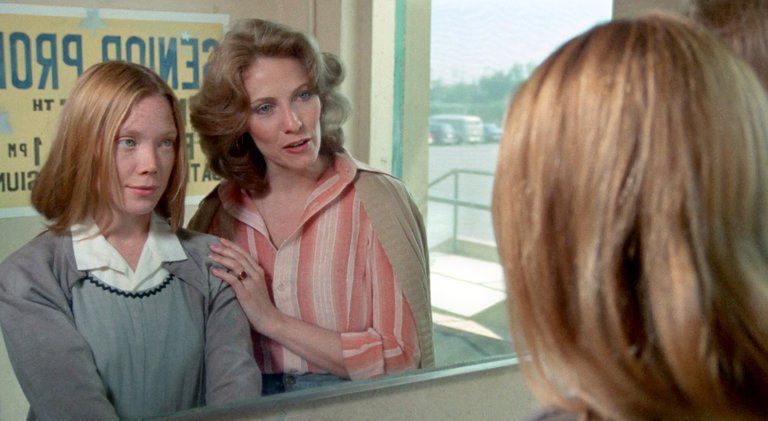
There are many different ways Carrie hides herself by masquerading throughout the film. Once Miss Collins pulls Carrie aside, she gets a new way to hide herself and fit in all at once. Miss Collins tells Carrie that if she curls her hair, and wears some lipstick and a little makeup, she can look very pretty and look like she belongs with the other girls at prom. Shelley says how, “Carrie builds up the surface of her body, as if to cover over what lurks beneath.” This demonstrates how that when she embraced her femininity with makeup and doing her hair, she hid more and more of the monster within, or her telekinetic powers. While putting on the makeup and ignoring what her mother told her about going to prom, she embraced her femininity, which inevitably leads to her becoming monstrous.

    Carrie is very conflicted throughout the entire film. She switches back and forth from believing that her femininity makes her pretty and mature, to that same femininity makes her monstrous and ashamed. This is well shown in the two almost mother figures she has, her actual mother, and Miss Collins. Her mother tells her to cover up, and that her femininity is a sin and that she must be sinning because she got her first period. Miss Collins is the exact opposite. She convinces Carrie to go against what her mother wants for the first time, and to embrace her femininity by using makeup, curling her hair, and wearing a pretty dress to the prom. Carrie’s mother wears dark, out-dated clothes, while Miss Collins is, “braless, physically active, and dressed in shorts and a T-shirt.” This further contrasts the two women, and demonstrates their two different outlooks in regards to femininity and womanhood. Miss Collins embraces hers and wishes for Carrie to do the same, while her mother wants for it to all be repressed and hidden away. 

Image result for miss collins carrie
Credit: MGM

    Carrie’s monstrous femininity wins out in the end. Almost as a punishment for accepting her femininity and going against her mother’s sexual oppression, Senior Prom is destroyed in a fiery inferno created by her telekinesis. While some people think that this scene just the healthy expression of her repressed sexuality, Shelley sees it as, “the failure of repression to contain the monstrous femine.” This would explain even more how her femininity was the monster the entire film. Carrie embraced and owned her femininity, even making her own dress for the prom, and it didn’t change how anyone at school thought of her. She was still a freak even with the makeup and the pretty dress, and the monster finally took the vengeance Carrie was afraid to.

Image result for carrie prom
Credit: MGM

The Exorcist!

When Regan is first possessed by the demon, no one knows that anything is wrong with her. She and her mother Chris live a perfectly normal life, if not for the absence of her father. It doesn’t seem like Regan is at the point of trying to push her mother away, and she still plays with her mom and they go on outings. This shows how Chris hasn’t quite become the aject mother as referred to in Creed’s writings. She does demonstrate the maternal authority, which according to Creed is, “the trustee of that mapping of the self’s clean and proper body”. Chris shows this well while she’s cleaning Regan in the bath after Regan had an accident in front of all her mothers friends at their party. This shows something that would be inappropriate in a different situation, but since it’s mother and child, it changes the context completely.

Image result for the exorcist regan in tub
Credit: Warner Bros.

One main way abjection is shown in horror films is just having a lot of images of abjection in general. Regan causes plenty of instances of this, at various points in the film. As stated in Creed’s work, “a more archaic level the representation of bodily wastes may evoke pleasure in breaking the taboo of filth”, as demonstrated how demon-Regan laughs and laughs after throwing up on Father Karras went to visit her, and covering her mother in blood. The evil being possessing Regan is enjoying crossing the unsaid borders that come with abjection, as shown by how often some type of bodily fluid is used to disgust all of the adults trying to save Regan. The abjection comes from, “these images of bodily wastes threaten a subject that is already constituted, in relation to the symbolic, as “whole and proper”.” In this case, Regan is a young girl who acts properly and like the perfect daughter, before her possession. When she’s taken over, the demon uses the bodily fluids as a way to make Regan not the proper girl she was before, using blood, vomit, and pee to cause discord. 

Image result for the exorcist puking
Credit: Warner Bros.

There’s also the abjection that has to do with the crossing the border of good to evil. Regan being possessed is an example of this. When one thinks of someone good, it’s hard to go wrong with a happy little girl who has a good relationship with her mom and usually gets what she wants. Then, when one looks at the demon possessing her, the contrast is stark. The demon-Regan spits and pukes, and uses vulgar language, while the original Regan liked to make arts and crafts and play games. The battle between good and evil is very clearly portrayed by Regan and the demon inside her, and the evil crosses the border of social niceties making the abjection present for all to see.

Scream!

    The movie Scream is a great example of a meta-film. The characters reference various other horror films throughout the movie, ranging from the characters taking inspiration from the movies to just discussing what the people in the films did wrong. When the killer confronts Tatum Riley, she thinks it’s just a joke, and does what every dying girl does in a horror movie, and it ends up killing her. Tatum asks the killer if she’s supposed to act like all the girls who get killed in movies, and she takes it as a joke until she’s actually stabbed. While the boys are in the video store, Randy almost figures out the whole plot of the movie by describing how other horror film killers would have acted in this case. He also tells everyone that going off alone, or to have sex, will result in them getting killed. All the slasher films have the same components, described in Clover’s work as “killer, locale, weapons, victims, and shock effects”.

As soon as Sidney has sex with her boyfriend, the killer appears once again to kill her. This demonstrates one of Clover’s points about the components of victims in slasher films, that, “killing those who seek or engage in unauthorized sex amounts to a generic imperative of the slasher film”. Tatum also gets killed, and it’s obvious throughout the film that she and Stu are actively having sex. Randy even says while he’s watching Halloween with the group that the way to survive a horror movie is to not have sex, and to avoid other “sins” like drinking and doing drugs. Everyone laughs, but Randy is left one of the last people standing when he reveals that he’s a virgin.

Jamie Kennedy in Scream (1996)
Credit: Dimension Films

Billy has childhood trauma as his catalyst for killing. He says how his mom left his dad and abandoned him because Sidney’s mom slept with his dad. Her mom doing that ruined Billy’s parents marriage, and by extent, his childhood. Billy takes out his frustrations on the women in the film, focusing on their deaths being more gruesome and more intimate then when he kills the men. When Kenny the camera man is killed, it’s almost a merciful death compared to that of Tatum, who was killed by the garage door. This supports Clover’s idea that, “the death of a male is always swift […] he is dispatched and the camera moves on”. In the beginning of the film, Casey’s death is long and drawn out, and ends with her being strung up on a tree with her organs on the ground, while her boyfriend was just gutted, which is a quick death in comparison. 

Image result for scream tatum stuck
Credit: Dimension Films

Halloween!

The way that Michael Myers gazes at his sister is the first time he releases his fury. The way that Michael acts in nicely summed up by Carol J. Clover in Her Body, Himself, where she says, “The notion of a killer propelled by a pyschosexual fury”, which is exactly what Michael is. The majority of Michaels kills are people in relation to sex. His first kill is his sister after he sees her having sex, which triggers something inside of him. The two girls Laurie is friends with die when they only have sex on the mind. Annie was in the process of going to pick up her boyfriend and Lynda had just had sex with her boyfriend when they both are killed by Michael. This shows how Michael hasn’t escaped from “the grip of boyhood” (Her Body, Himself), and he hasn’t gotten past the trauma of his sister in his childhood.

Image result for original halloween movie michael sees his sister
Source: Compass International Pictures

Michael isn’t just a normal person according to Dr. Loomis. Loomis claims that Michael isn’t even a man. This falls into line with how Clover says that the new type of killers, “only role is that of a killer” and “they may be recognizably human, but only marginally so”. Dr. Loomis keeps telling people Michael isn’t a man. Loomis also touches on how Michael’s eyes are like the devil’s eyes, and that he has black eyes. They say the eyes are windows to the soul, and Michael having black eyes lends to the idea that he isn’t a man, just a killer, whose soul is only darkness.

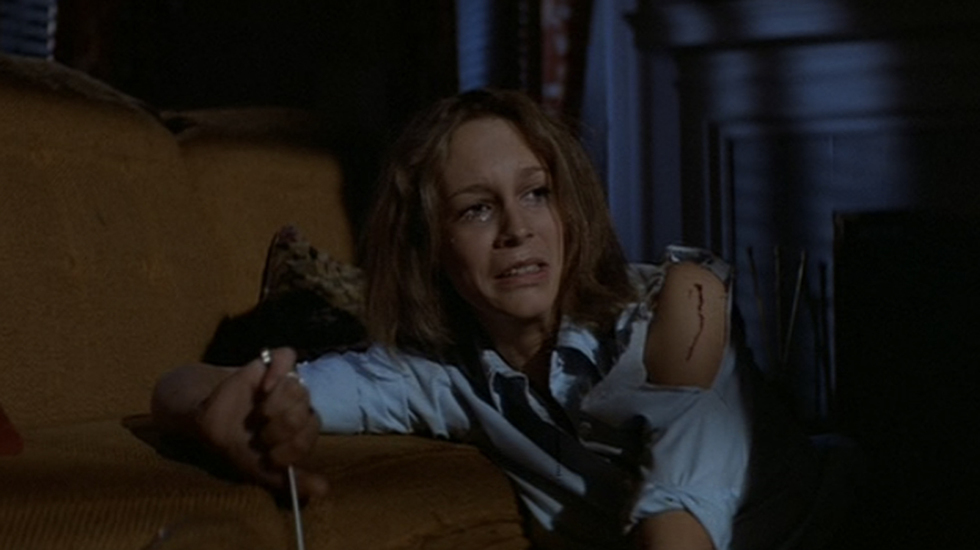
    Laurie is the basic final girl. At first, she doesn’t realize anything is wrong, and she just assumes that her friends are messing around with her like they usually do. She’s in denial, until she goes to check on her friends and finds them all dead. In an excerpt of Her Body, Himself, Clovers says, “she is the one who encounters the mutilated bodies of her friends and perceives the full extent of the preceding horror and of her own peril”. Laurie knows she’s next once she finds the bodies of her friends, and runs for her life. She embraces her final girl situation, and uses what she has nearby (first a knitting needle) to incapacitate Michael. While this doesn’t work out for her in the long run, it is long enough for her to get the kids to safety and enough time for help to arrive in the form of Dr. Loomis.

Image result for original halloween movie knitting needle
Source: Compass International Pictures

Psycho!

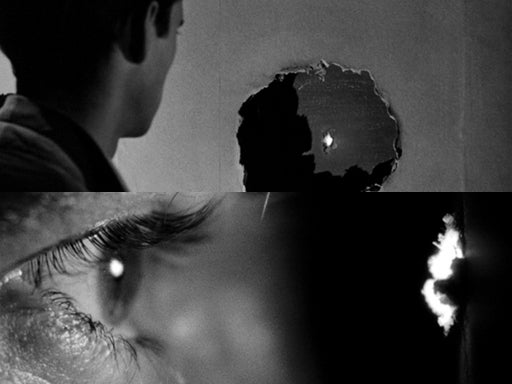
In Psycho, Norman Bates is shown to be a truly distrubed person. Norman has scopophilia, as demonstrated how he enjoys watching Marion undress before she gets in the shower. As stated in Laura Mulvey’s “Visual Pleasure and Narrative Cinema”, she states how scopophilia is associated, “with taking other people as objects, subjecting them to a controlling and curious gaze. [Some] particular examples center around the voyeuristic activities of children”. This applies to Norman, in the way that his “Mother” still treats him as a child who isn’t able to be with a woman. The way Norman watches Marion is with a fascination, and admiration, and gets pleasure from simply watching her. In contrast, while the scene of Marion undressing for her shower was for the pleasure of Norman, the next scene of Marion in the shower is for the audience’s pleasure. There are no characters on screen to watch Marion, until “Mother” bursts in to kill her. This shows that the scene of Marion naked in the shower was to appeal to the gaze of the male audience members. This scene abruptly ends when “Mother” comes in response to the anxiety felt by Norman.

Image result for psycho movie norman peep hole
Source: Universal Pictures

    Norman’s “Mother” personality comes out when he starts to feel some castration anxiety. The first time it happened, Marion was nice to Norman and told him to get out of the motel if he could, and that he doesn’t owe anything to his mother. Norman feels subdued after hearing this, and becomes intimidated by Marion being an independent woman. That, coupled with Norman watching her undress was enough to make “Mother” come out and get rid of the problem. As stated in “Visual Pleasure and Narrative Cinema”, one reason someone would experience “symbolise the castration threat by her real absence of a penis” as demonstrated by Marion in this scene. When the private investigator comes around to the motel to ask questions, Norman is intimidated and flustered by what was asked and how aggressively he was being interrogated. This was a verbal pissing contest, and Norman lost. This castration anxiety once again made “Mother” come out and solve the problem.

    The way the castration anxiety is solved is with the knife used to kill all of “Mother”’s victims. It is quite a large knife, that is effectively used to penetrate all of the victims, from Marion, the private investigator, and the almost murder of Sam. These people intimidated Norman, to the point where his “Mother” personality came out and felt the need to stop what was giving Norman those feelings and to protect him. As stated in “When the Woman Looks” by Linda Williams, Norman’s “Mother ” emerges whenever he feels sexual desire for a woman. This also gives the mother personality her own type of castration anxiety almost, in relation to how she feels inadequate compared to the women stealing her child’s attention away from her, so she responds by killing them.

Image result for psycho norman private investigater
Source: Universal Pictures

Design a site like this with WordPress.com
Get started